Description
Early Ladik Prayer Rug
Ladik, Konya region, Central Anatolia
Circa 1800–1830
Wool pile
Professionally conservation-mounted on linen
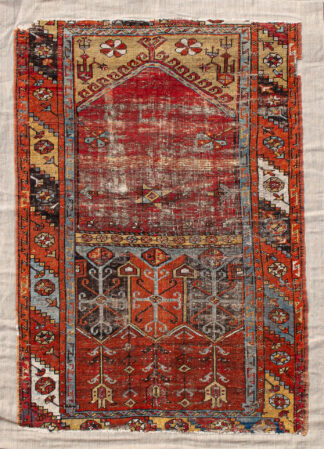
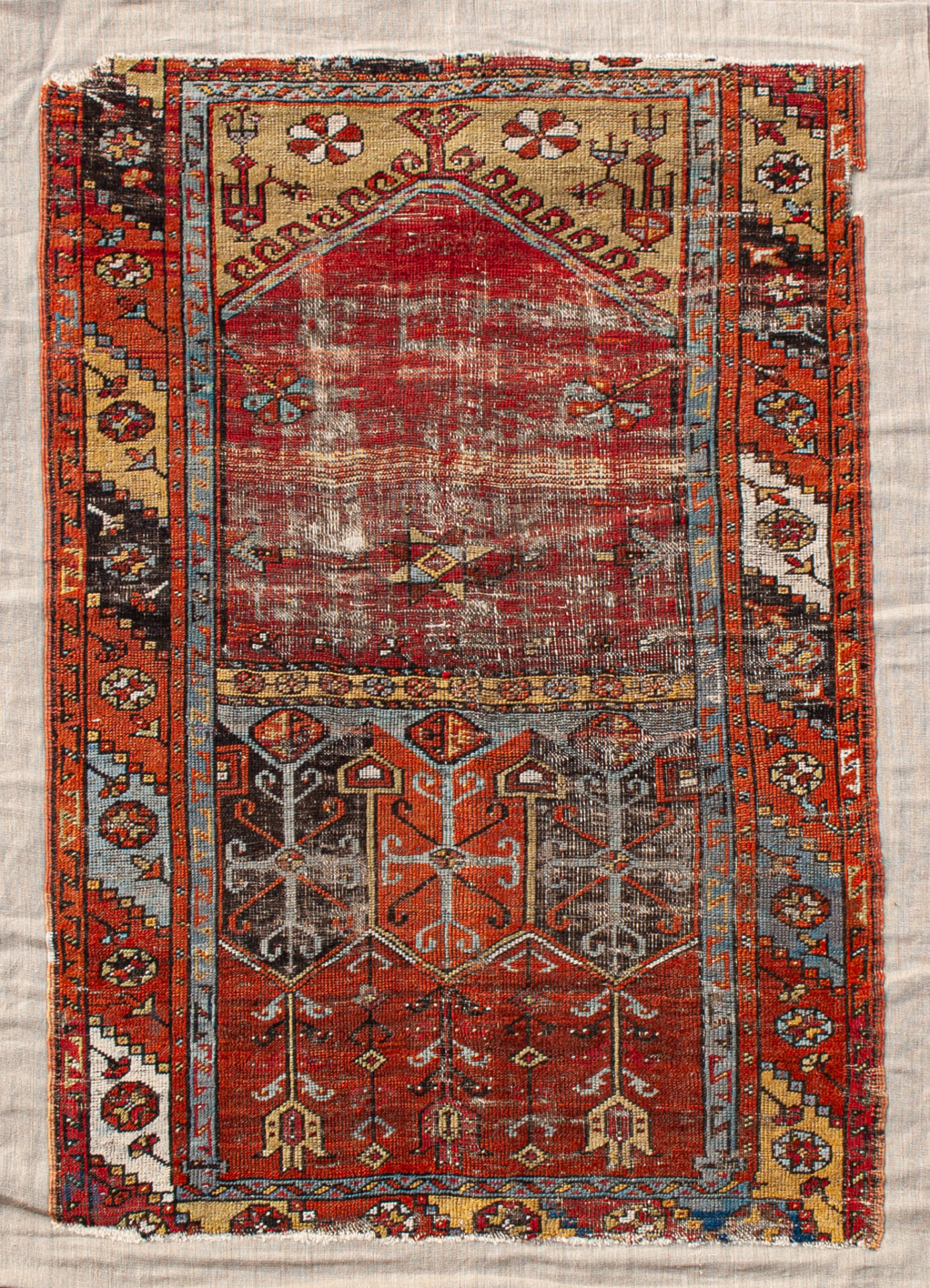
An early nineteenth-century Ladik prayer rug distinguished by its strongly architectural composition and evocative, time-softened palette. The red prayer field rises into a steep triangular mihrab outlined in pale blue. Its warm yellow spandrels contain geometric flowers and smaller stylised vegetal or amuletic devices, while a branching finial crowns the apex of the niche.
The particularly striking lower panel is divided into three gabled compartments, each containing a highly abstracted flowering plant or tree. Additional slender plants rise from the red ground below. This formal garden-like arrangement belongs to the established vocabulary of Ladik prayer rugs, in which tulips and other Ottoman floral forms were progressively transformed into powerful geometric ornaments.
A broad border of polychrome rosettes and angular flowering stems surrounds the composition, accompanied by narrow pale-blue guard borders. The palette combines madder-like reds, warm yellow, soft blue, ivory and dark brown, with extensive natural variation and abrash.
The rug has experienced substantial devotional use. Much of the pile in the central field has worn away, exposing the underlying structure, and there are losses and areas of deterioration around the borders and ends. It has therefore been professionally mounted on linen, both to stabilise the surviving fabric and to allow it to be displayed safely. The mounting does not disguise its condition: the wear remains an integral and visually compelling part of the rug’s history.
Despite its fragmentary state, the principal composition remains remarkably legible. Its age, rare lower-panel design and sculptural surface give it the presence of an archaeological textile as much as a domestic object.