Description
Rare Double-Register Mucur Prayer Rug
Mucur, Kırşehir region, Central Anatolia
First half of the 19th century, circa 1820–1850
Wool pile
Professionally conservation-mounted on linen
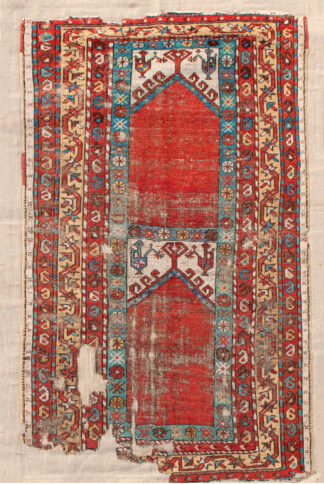
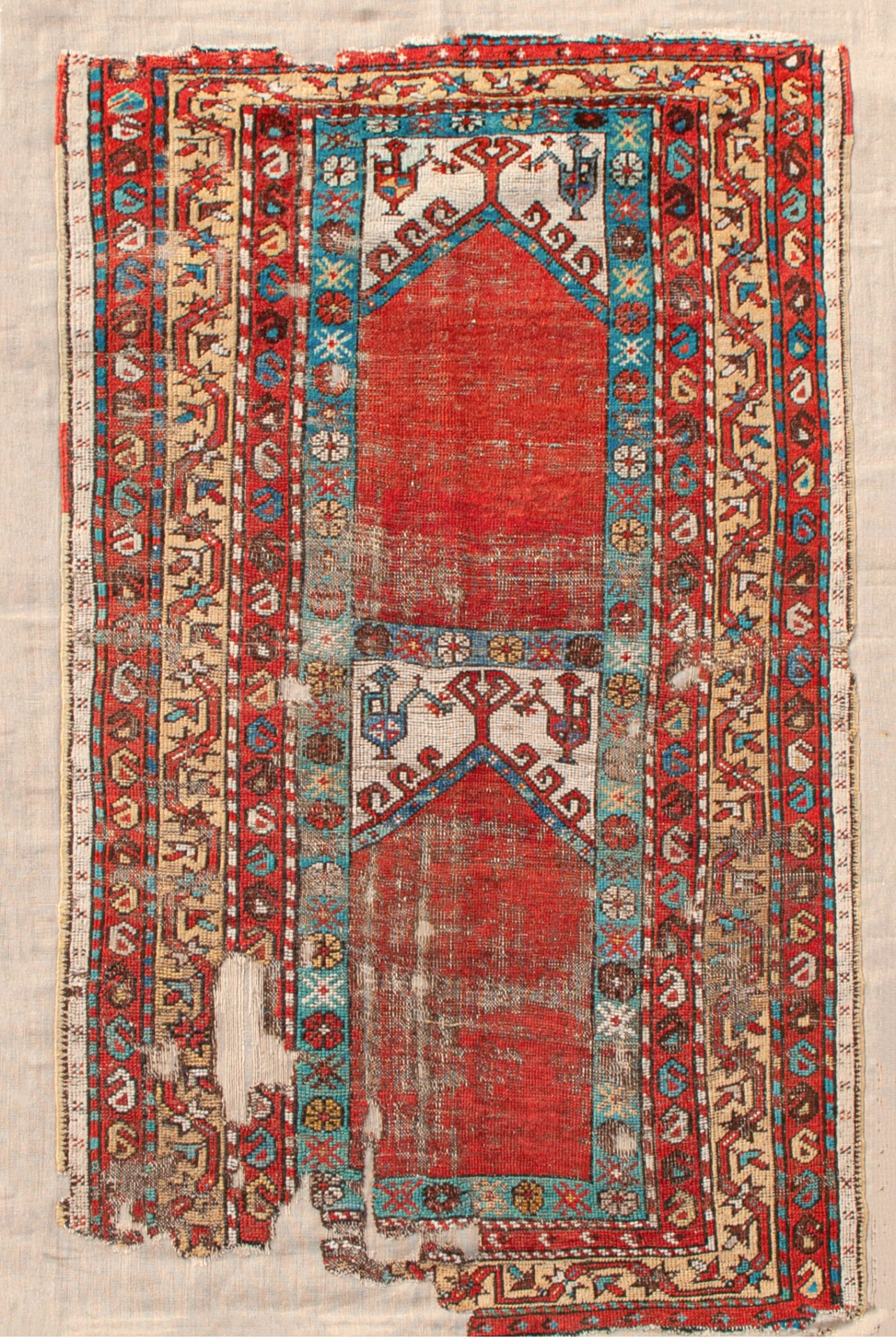
An exceptionally rare Mucur prayer rug constructed around two complete prayer niches arranged vertically, one above the other and pointing in the same direction. This unusual stacked composition should be distinguished from a conventional saf, in which several niches are normally placed side by side to accommodate a row of worshippers.
Each register contains an open ruby-red field beneath a sharply pitched arch outlined in turquoise blue. The ivory spandrels are ornamented with a branching tree-like finial and paired water ewers, or ibriks. These vessels, associated with ritual washing and purification, are particularly characteristic of the prayer rugs woven around Mucur and Kırşehir.
Turquoise borders filled with polychrome rosettes surround the two niches. Beyond them lies an unusually rich succession of narrow guard borders containing reciprocal hooks, angular vines, small flowerheads and multicoloured geometric devices. The broad ivory-ground border carries a strongly drawn meandering vine, giving structure to the otherwise kaleidoscopic palette of ruby red, turquoise, yellow, ivory and dark brown.
The rug has survived in a highly fragmentary condition, with extensive pile loss, exposed foundation and substantial losses to the lower end and left side. It has been professionally mounted on linen to stabilise the surviving material and permit safe display. No attempt has been made to disguise its age or reconstruct the missing portions.
Despite its condition, both prayer niches and most of the complex border system remain legible. Its unusual two-tier composition, characteristic Mucur water ewers and luminous colour make it an important surviving example of nineteenth-century Central Anatolian devotional weaving.